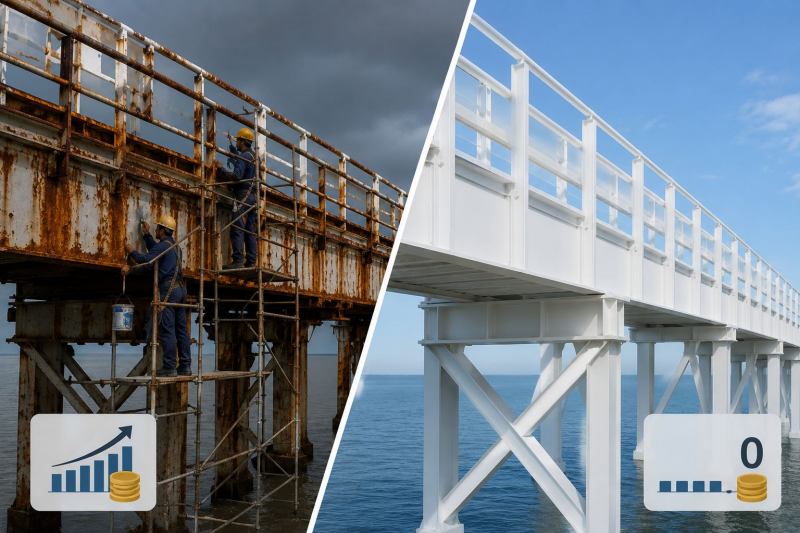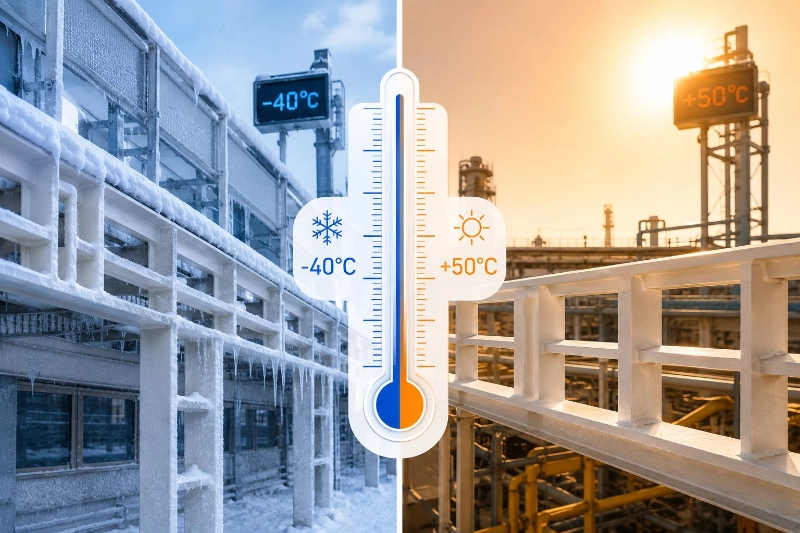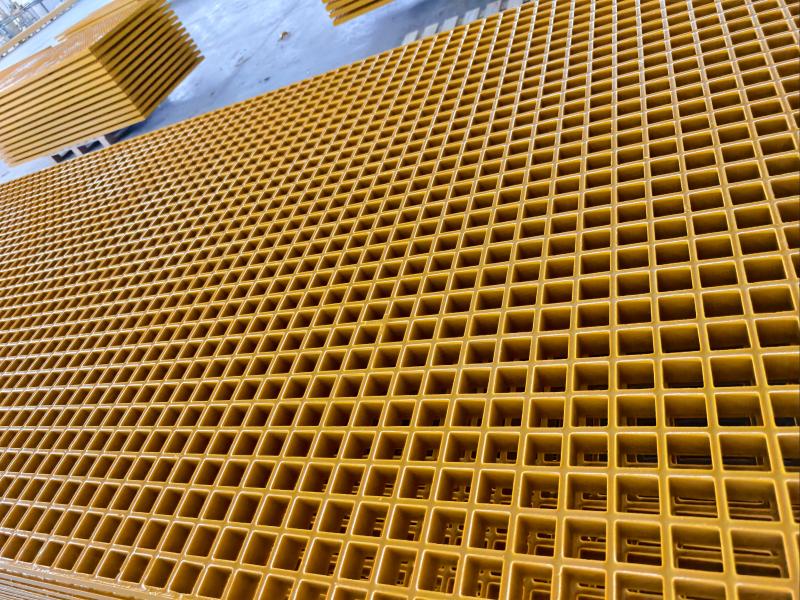
With the escalating requirements for safety protection and environmental performance in modern architecture, FRP (Fiberglass Reinforced Plastic) guardrails have stood out with multiple advantages, becoming the preferred solution for various engineering projects.
Read MoreIn modern construction engineering, FRP cable trays, as a new type of composite material facility with glass fiber as the main reinforcing material and resin as the matrix, boast remarkable advantages. They have excellent corrosion resistance and can resist the erosion of chemical media; meanwhile, ......
Read MoreIn modern engineering and manufacturing, material selection has a direct impact on safety, durability, and long-term performance. For decades, steel has dominated construction, transportation, energy and industrial applications thanks to its high strength and well-established processing methods. But......
Read MoreThe performance core of glass fiber pultruded profiles is determined by the resin matrix. Three mainstream materials, namely vinyl ester, isophthalic polyester and ordinary epoxy, have their own focuses in terms of mechanical strength, corrosion and heat resistance, processing cost and other dimensi......
Read MoreAs industries and construction technologies continue to evolve, the selection of structural materials has become increasingly sophisticated. For decades, aluminum has been the go-to material thanks to its light weight, strength, and ease of fabrication. Yet, with the growing maturity of composite te......
Read MoreThe story of FRP (Fiber-Reinforced Polymer) began as early as 3400 BC. The ancient Mesopotamians made plywood by gluing wooden strips at different angles, and the ancient Chinese used straw mixed with clay to build houses. These were all early practices of natural composite materials. The composite ......
Read More