

FRP Composites and Sustainability: The Environmental Case
Sustainability is becoming an increasingly important consideration for procurement teams across the construction, energy and industrial sectors.
When selecting structural materials, companies are looking not only at performance and cost, but also at carbon emissions, maintenance requirements, service life and overall environmental impact.
FRP composites can offer several advantages in these areas.
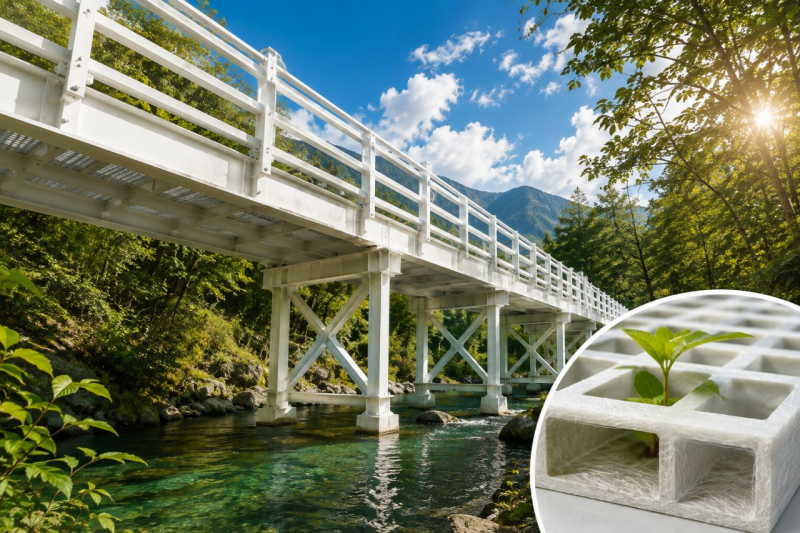
Lower Carbon Footprint
According to a carbon footprint report issued by the Shanghai Research Institute of Building Sciences, FRP profiles have a total carbon emission of approximately 3.15 kg CO₂ per kg of product across raw material extraction, transportation, production and end use.
The same lifecycle analysis indicates that FRP profiles can produce up to eight times less CO₂ per kilogram than equivalent aluminum profiles, depending on the materials and lifecycle assumptions used.
For large infrastructure projects requiring significant quantities of structural material, these differences can become particularly relevant to overall project emissions.
Reduced Maintenance Requirements
Corrosion protection is another important environmental consideration.
Steel structures operating in aggressive environments may require periodic surface treatment, repainting and protective coatings. These maintenance activities consume additional materials and generate waste over the service life of the structure.
FRP does not rust and generally does not require conventional anti-corrosion coatings. This can reduce the materials, labor and environmental impact associated with recurring corrosion maintenance.
Long Service Life
Sustainability is also closely connected to durability.
Replacing structural components requires additional raw materials, energy, transportation and construction work. A longer service life can therefore help reduce the frequency of replacement and the associated resource consumption.
FRP composite products are designed for long-term performance and can provide 50+ years of service life in suitable applications and operating conditions.
Applications in Environmentally Sensitive Environments
FRP's resistance to corrosion and moisture makes it suitable for applications where environmental exposure is a major concern, including:
● Water and wastewater treatment
● Marine and coastal infrastructure
● Aquaculture facilities
● Food-processing environments
● Chemical and industrial facilities
Its non-corrosive nature also eliminates rust-related deterioration associated with conventional steel structures.
FRP and ESG Objectives
For companies working toward ESG and carbon-reduction targets, material selection can play an important role in reducing the environmental impact of infrastructure projects.
The potential benefits of FRP include lower lifecycle emissions, reduced corrosion-related maintenance and long service life.
However, the actual environmental impact depends on the specific product, materials, manufacturing process, transportation and end-of-life scenario. For this reason, project-specific lifecycle analysis provides the most accurate assessment.
Looking for a More Sustainable Structural Solution?
Nanjing Spare New Materials can provide FRP composite solutions for construction, energy, infrastructure, water treatment and industrial applications.
Contact us with your drawings and project requirements to discuss the appropriate FRP solution and request relevant technical and environmental documentation.