

FRP vs Steel: Why Total Cost of Ownership Matters More Than Purchase Price
When selecting materials for industrial and infrastructure projects, procurement teams often focus on one key figure: the initial purchase price.
Engineering and project teams, however, typically look at a broader question: how much will the material cost throughout its entire service life?
This difference is particularly important when comparing FRP composite profiles with conventional steel in environments exposed to moisture, chemicals, salt and other corrosive factors.
Although FRP products can have a higher initial purchase price than standard structural steel, their corrosion resistance, low maintenance requirements and lightweight design can significantly reduce lifecycle costs.
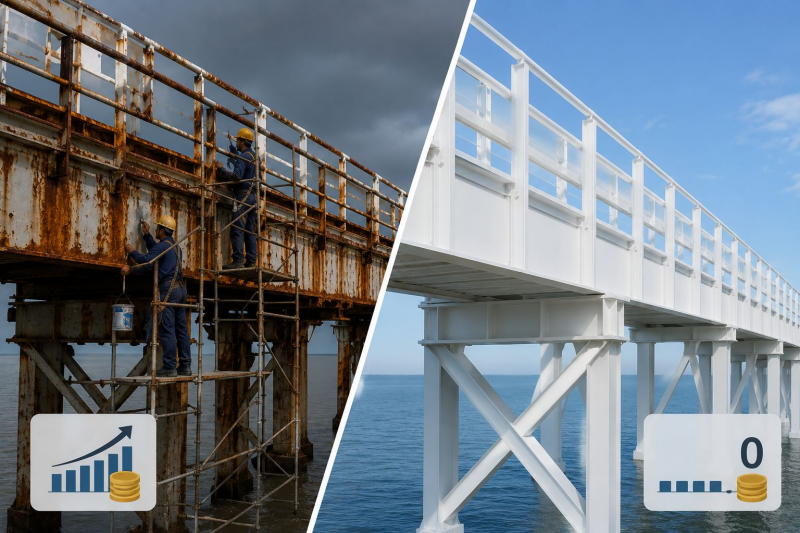
The Initial Purchase Price: Year 0
At the procurement stage, steel often appears to be the more economical option.
Standard structural steel is widely available and has a relatively low initial purchase price. FRP profiles, on the other hand, can require a higher upfront investment due to the cost of composite materials and specialized manufacturing.
However, the purchase price represents only the beginning of the material's economic lifecycle.
For long-term projects, the more relevant question is:
What will the total cost be after 5, 10 or 20 years of operation?
Years 1–5: Maintenance Begins
In corrosive or humid environments, steel structures typically require regular inspection and protective measures.
Depending on the operating conditions, this can include:
● Anti-corrosion inspections
● Touch-up coating and protective treatments
● Surface preparation and repainting
● Monitoring of early corrosion
● Additional maintenance in marine and chemical environments
FRP composites behave differently.
Because FRP does not rust and offers strong resistance to moisture and many corrosive environments, routine corrosion-related maintenance can be significantly reduced compared with conventional steel.
This can also reduce the need for maintenance-related access, labor and operational interruptions.
Years 5–10: The Lifecycle Cost Gap Grows
As steel structures remain exposed to aggressive environments, maintenance requirements can become more significant.
Depending on the project and environmental conditions, steel may require:
● Major repainting cycles
● Detailed structural inspections
● Local repairs or component replacement
● Additional corrosion protection
● Labor and equipment for maintenance operations
● Potential downtime during maintenance
FRP, by contrast, is designed to provide long-term performance with minimal routine maintenance.
The absence of corrosion-related repainting and repair requirements can become a significant economic advantage over longer project lifecycles.
Years 10–20: Looking Beyond the Purchase Price
For infrastructure expected to operate for decades, the cumulative cost of maintenance becomes increasingly important.
Repeated coating, inspection, repair and replacement cycles can substantially increase the total cost of a steel structure.
In some aggressive environments, accumulated maintenance expenses can approach or exceed the original purchase cost of the material.
FRP can help avoid many of these recurring corrosion-related expenses.
Its corrosion resistance and low maintenance requirements mean that, when properly designed and specified for the application, the additional operating expenditure can remain relatively low throughout the service life.
The Other Economic Advantage: Lower Weight
Lifecycle economics are not limited to maintenance.
FRP profiles are significantly lighter than steel. Depending on the specific profile and design, FRP can weigh up to approximately 75% less than steel.
This can create additional savings during:
● Transportation
● Handling
● Installation
● Structural support design
● On-site assembly
A lighter material can also simplify installation in locations where access for heavy lifting equipment is difficult.
For large infrastructure projects, these indirect savings can have a meaningful impact on the overall project cost.
FRP vs Steel: A Lifecycle Perspective
When comparing materials, it is useful to look at the main cost factors together:
| Cost factor | Steel | FRP |
| Initial purchase price | Generally lower | Generally higher |
| Corrosion resistance | Requires protection in corrosive environments | High corrosion resistance |
| Repainting | May be required periodically | Generally not required for corrosion protection |
| Maintenance labor | Can be significant | Typically low |
| Weight | Heavy | Significantly lighter |
| Installation | May require heavier equipment | Easier handling in many applications |
| Long-term operating costs | Can increase over time | Generally lower |
| Suitable environments | General construction | Particularly suitable for corrosive and humid environments |
The exact lifecycle economics will always depend on the application, material specifications, environmental conditions, installation method and expected service life.
Real-World Applications
The advantages of FRP are particularly relevant in environments where corrosion and maintenance are major concerns.
Examples highlighted by Nanjing Spare include applications in:
Cable Bridge Systems in Norway
FRP components have been supplied for cable bridge systems in cooperation with Oglaend Industries. According to the project information, the systems have operated for approximately 10 years without documented maintenance interventions.
Rama 8 Bridge — Bangkok
FRP deck sections have been used on the Rama 8 Bridge in Bangkok since 2001. The application demonstrates the potential of FRP components for long-term infrastructure use without conventional steel repainting requirements.
Shenzhen Water Treatment
In a water-treatment application, metal scraper components experienced failures after several years of operation. FRP replacements were subsequently introduced and have operated with significantly reduced maintenance requirements.
Zhenhai Refining Cooling Towers
FRP components were introduced in cooling tower applications to replace metal components and reduce recurring replacement requirements.
These examples illustrate why composite materials are increasingly considered for infrastructure exposed to water, humidity, chemicals and other aggressive operating conditions.Beyond Maintenance: Sustainability ConsiderationsLifecycle cost is not the only factor that can influence material selection.
FRP's low weight can reduce transportation and installation requirements, while composite manufacturing can have a lower carbon footprint than some alternative materials.
The source data for this analysis indicates that FRP manufacturing can have a carbon footprint up to 8 times lower than aluminum, although the actual environmental impact depends on the specific materials, manufacturing process, transportation and end-of-life scenario.
For projects where both economic and environmental performance are important, lifecycle analysis can therefore provide a more complete picture than purchase price alone.
What Should Procurement Teams Consider?
A material that is cheaper to purchase is not necessarily cheaper to own.
When evaluating FRP against steel, procurement and engineering teams should consider:
● Initial purchase price
● Expected service life
● Corrosion exposure
● Inspection requirements
● Repainting frequency
● Maintenance labor
● Replacement costs
● Installation and transportation
● Downtime during maintenance
● Environmental conditions
● Required structural performance
For projects with long service requirements, especially in marine, wastewater, chemical, petrochemical and other corrosive environments, these factors can have a major impact on the final economics.
FRP: Evaluating the Full Asset Lifecycle
FRP should not simply be evaluated as a more expensive alternative to steel.
The more useful comparison is the total cost of ownership over the expected service life of the asset.
A higher initial investment can potentially be offset by reduced corrosion-related maintenance, easier installation, lower replacement requirements and longer service performance.
For projects with service requirements of 10, 20 or more years, evaluating the complete lifecycle cost can provide a much clearer basis for material selection than comparing purchase prices alone.
Need a Lifecycle Cost Comparison?
Every project is different. Environmental conditions, dimensions, quantities, loading requirements and expected service life all influence the final economics.
Nanjing Spare New Materials can evaluate FRP solutions according to your project requirements and provide a customized technical and commercial proposal.
Send us your drawings, specifications and project requirements, and our team can help compare the potential lifecycle benefits of FRP against conventional materials.